
Key point: If your problem statement fits every study, it fits none.
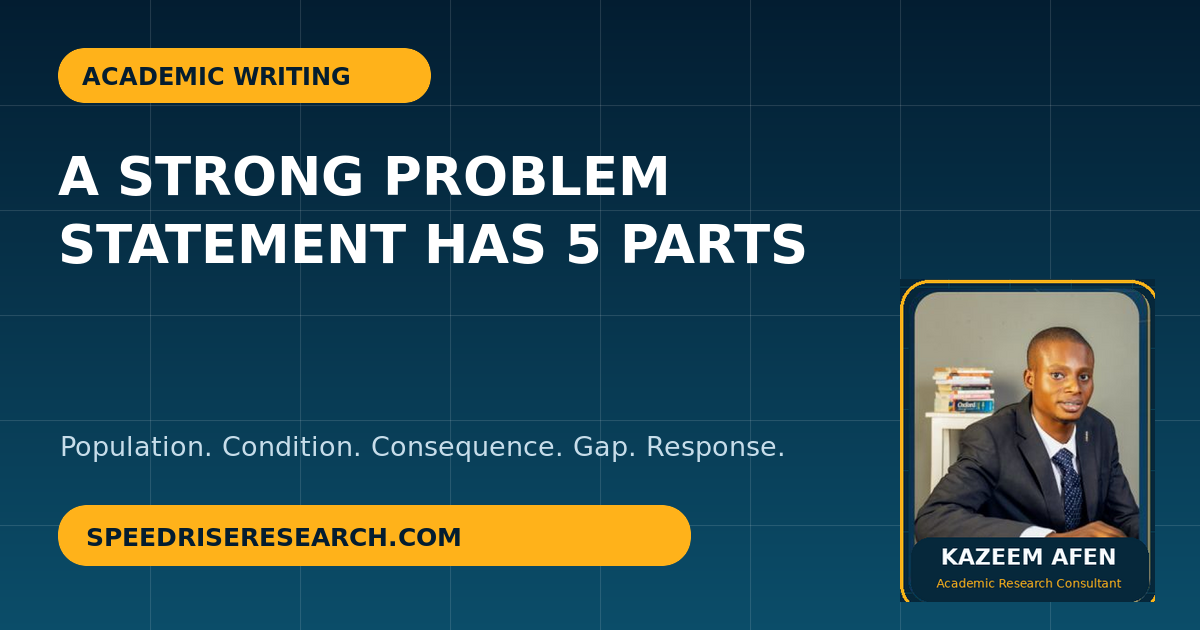
Use this five part framework to write a research problem statement that identifies the population, condition, consequence, evidence gap and study response.
The five essential elements
A strong problem statement identifies the affected population or setting, the documented condition, the practical or scholarly consequence, the evidence that remains insufficient and the specific way the proposed study will investigate the issue.
Move from broad to precise
Briefly establish the wider concern, then narrow the discussion to the exact setting and population. Use credible evidence to demonstrate the problem. Avoid filling the section with general background that does not lead to the study.
Separate the practical problem from the evidence problem
A practical problem may be high staff turnover, delayed care or poor technology adoption. The research problem is what reliable evidence still cannot explain about that condition. Both should be visible and connected.
Final quality check
Ask whether the section shows who is affected, what is happening, why it matters, what remains unknown and how the study responds. If one of these is missing, the problem statement is incomplete.
How Speedrise Research can help
We provide research writing guidance, academic editing, quantitative and qualitative analytical assistance, presentation development and responsible manuscript revision for undergraduate, master’s and doctoral researchers worldwide.
Need support with your research?
Send your academic level, research stage, deadline and required support through WhatsApp. We will review the scope and recommend the most appropriate service.

About the author
Kazeem Afen
Kazeem Afen is an academic research consultant at Speedrise Research. He supports undergraduate, master’s and doctoral researchers with research development, academic editing, quantitative and qualitative analysis, presentations and responsible manuscript revision.